The Cage
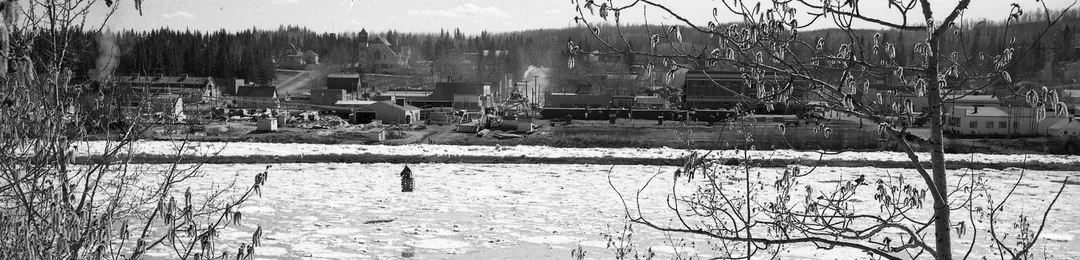
The cage, suspended from the ferry cables, crossing the Athabasca River, ND. Athabasca Archives, AA22891.
A major problem with the ferry/ice-bridge system of crossing the river were the long periods when it was unsafe to cross the river by either method – during spring break-up and freeze-over in the fall. According to records in the early papers, the ice generally went out about mid-April and the ferry could be launched safely once the ice had cleared. In the fall the ferry might be able to run as late as the end of October, but not always. And again, it wasn’t safe to cross until the river ice was thick enough to support the weight of people, teams and eventually vehicles.
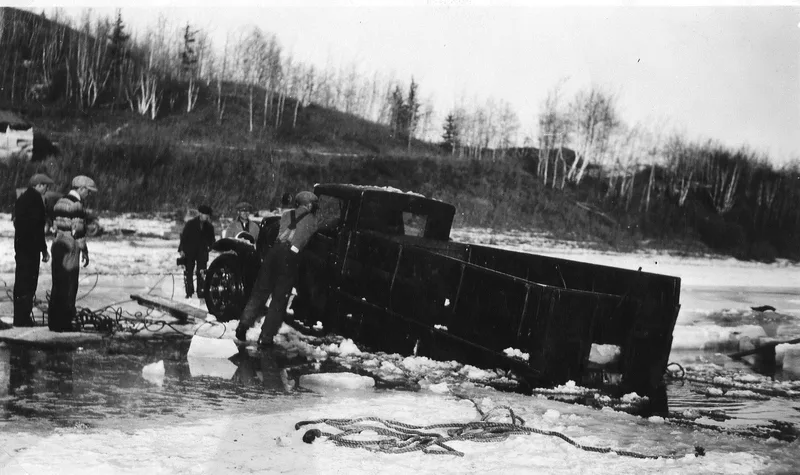
There was mention of the use of planks in the newspapers – one would assume to walk on when the ice was rotten. One item in the Athabasca Echo, April 11, 1941, was an entertaining piece about a crew of young men working in a lumber camp who decided they would like to spend a weekend in town and decided to drive to town on the river. Seven piled into a car and tied planks under it “just in case.” The planks held the car up just long enough for them to scramble to the bank and they were forced to walk back to camp. They returned the next morning to find their “streamlined Ford” in nine feet of water. They did manage to get it to shore using ingenuity and a lot of sweat.
A truck broken through the ice on the Athabasca River, c. 1930s. Athabasca Archives, AA00849.
Row boats and motor boats were often used during the in-between time. The Northern News of December 19, 1913, told of small boats carrying people across the river for one dollar per head until a gasoline-powered boat called Snowbird was launched and it charged only 50 cents.
As early as 1913, there were calls for something better. The November 21 issue of the Northern News reported: “People who have been brave enough to cross are compelled to pay one dollar each way. In case of sickness or getting letters or provisions, the hardships are too much to expect. Could not a basket be attached to the present cable so that small articles or even persons could cross? Meanwhile those anxious and hungry settlers on the other side have to wait. The authorities seem to have done all in their power to make things right, but the suggestion of a basket may be tried successfully, and they would receive the thanks of a long-suffering public.” The plea was repeated again the following year: “Are the people on the north side of the town this year to be again deprived of the facilities for having their mail transferred to this side? A basket attached to the overhead ferry would, simple as it is, make all the difference between first-class imprisonment and purgatory during the period when the ice makes passage impossible. The Board of Trade had the matter up last year, we believe, and may have it again. This time something ought to be done.” Northern News, June 19, 1914.
It wasn’t until 1934, after continued pressure on the provincial government for a bridge, that there was a response. April 13, 1934, The Athabasca Echo, reported: “After last autumn’s alarms, the Government promised some apparatus for [pedestrians] to get over for [emergency] needs and to provide a means of access for medical care. Last week the Dept. of Public Works sent up a crate with a cable [and] engine. This was installed and tested out, only to be found wanting in power to make the banks of either side. The engine was taken out and it is understood that a different gear is being attached, whilst a ladder and landing platform is being erected at the ferry towers.”
An article in The Echo the following week described the result: “The cable carrier operated by G. Cocke is proving quite a help to the Northsiders, although it is causing little Geoff much mechanical worry. The twin-cylinder motorcycle engine [won’t] stand up to the racket and the vibration [jars] some nut loose every trip. However, although slow and inefficient it is practical and safe. Three passengers is the limit per trip. The sag in the big cable (although tightened all it is possible) puts the crate within three feet of the water at the centre; which means that when the ice runs and the river rises the carrier will not be able to cross. And this is likely to be a twice a year condition, until a bridge materializes. The need of a bridge here has not been lessened, and as time goes on will be more and more imperative.”
And the following week: “Geoff Cocke, the pilot of the cable cage, dismantled the contraption on Wednesday morning, when the ice had run off and the ferry put in. Whilst somewhat of a nerve-wracking crossing, the cage has been a real boon to the Northsiders and an average of over 40 a day came over. Saturday 168 found the aerial bridge a blessing. Geoff was called once or twice for midnight [emergencies] but mostly a daylight service was sufficient, tho ’twas hard to drive some of the boys home to supper. The feeling of helpless isolation has been lifted by the government’s cable cage for absolute necessities during the river’s twice a year tie-up.”
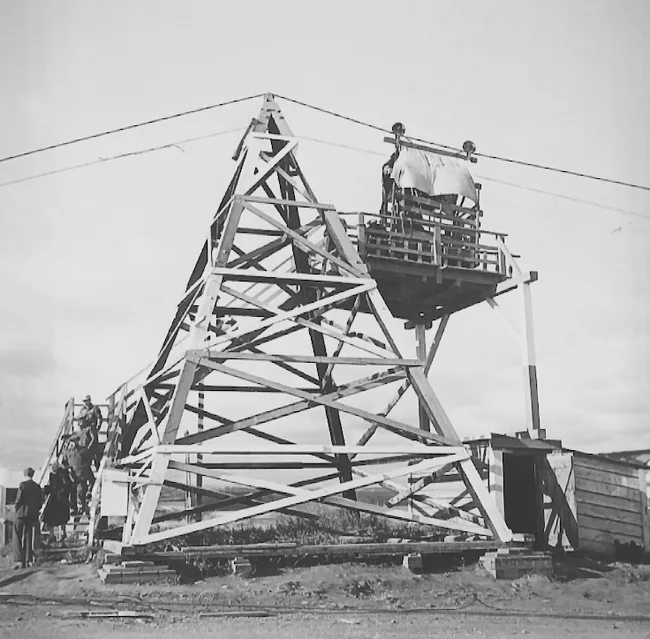
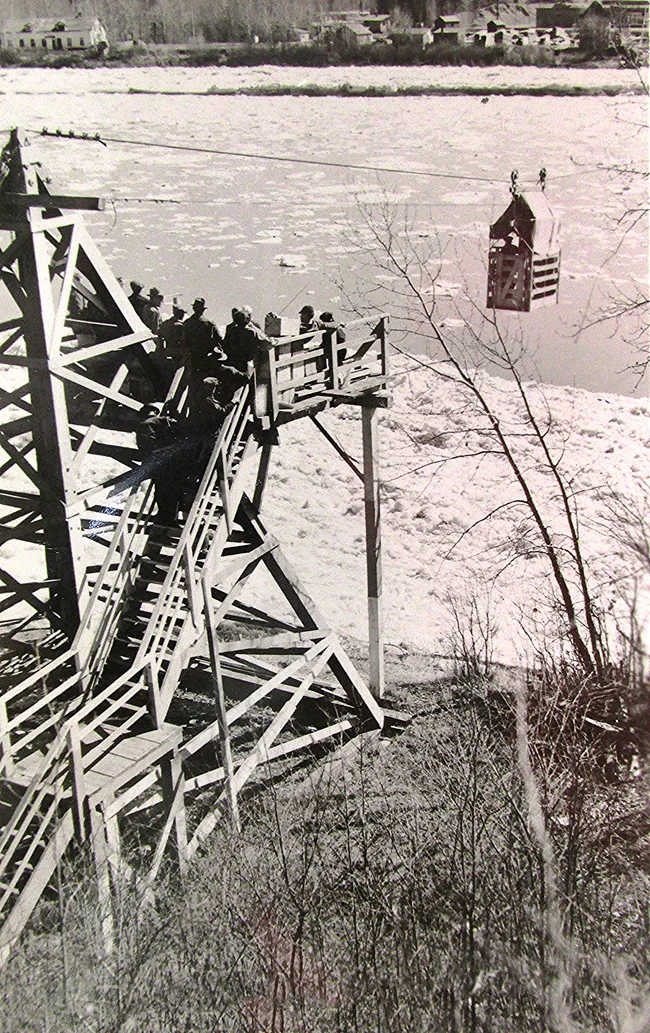
Boarding the cage from the platform built on the ferry tower, 1949. Athabasca Archives, AA22894.
By the end of November that year, the cage had been running for a month and because the ice was forming slowly, it was expected to possibly run until Christmas. The Echo, November 30, 1934, described it best: “Geoff is doing a roaring passenger service with his passenger cage on the ferry cable, which is a great improvement on last year’s rattle-trap. Four tons of flour and merchandise were taken over one day and it was some chore carrying it up the ladder and dropping it down the other side. 250 passengers made the trip on Saturday, but not a wagon load of produce for six or eight weeks is a hardship for a 2000 farm population.”
One does not find many early settlers with fond memories of crossing the river in the cage. At first, access to the cage was by means of ladders inside the towers. One early pioneer often told of the difficulty he had in the late 30’s getting his wife who was very ill with rheumatic fever up to the cage. The motor was suspended above the cage by posts inside of it and it was impossible to get her cot into the cage itself. She had to be suspended on her cot outside the cage on poles threaded through it. Happily, she survived. Stairs would eventually be added to the outside of the towers greatly improving access.
The proximity of the cage to the river at its lowest point made it dangerous for the cage to run during breakup if the water was high. One such incident is described by Frank Falconer in an Athabasca Archives February 1981 interview [Tape #17]: “…half the town was there…We were standing watching this thing. What happened, you see … there was a gap about this big in the base of the of the cage, and a big chunk of ice came and got into it, and added the weight of the ice to the cage so of course the cage sunk. And there was ice coming down the river and banging against this cage… And Slim Nelson was one of the crowd that was there. And he watched this for a little while, and he hollered, “Come on you guys, get on the cable.” So everybody that could ran over, and you know how the cable [sloped] down? Well Slim was the first guy, and of course, being pretty tall, he got pretty high up on that cable. I suppose it would be thirty or forty men, held on to this cable and they just got enough slack to get it started out of the water, and another cake of ice came down and hit it, and tilted it enough that the cake of ice that was in there slid out and that was a pretty scary …. one of those clevises let loose and [the cage] just hung on one clevis … way up there.”
Northsiders waiting their turn to cross the river to Athabasca, c. 1940s. Athabasca Archives, AA00392.
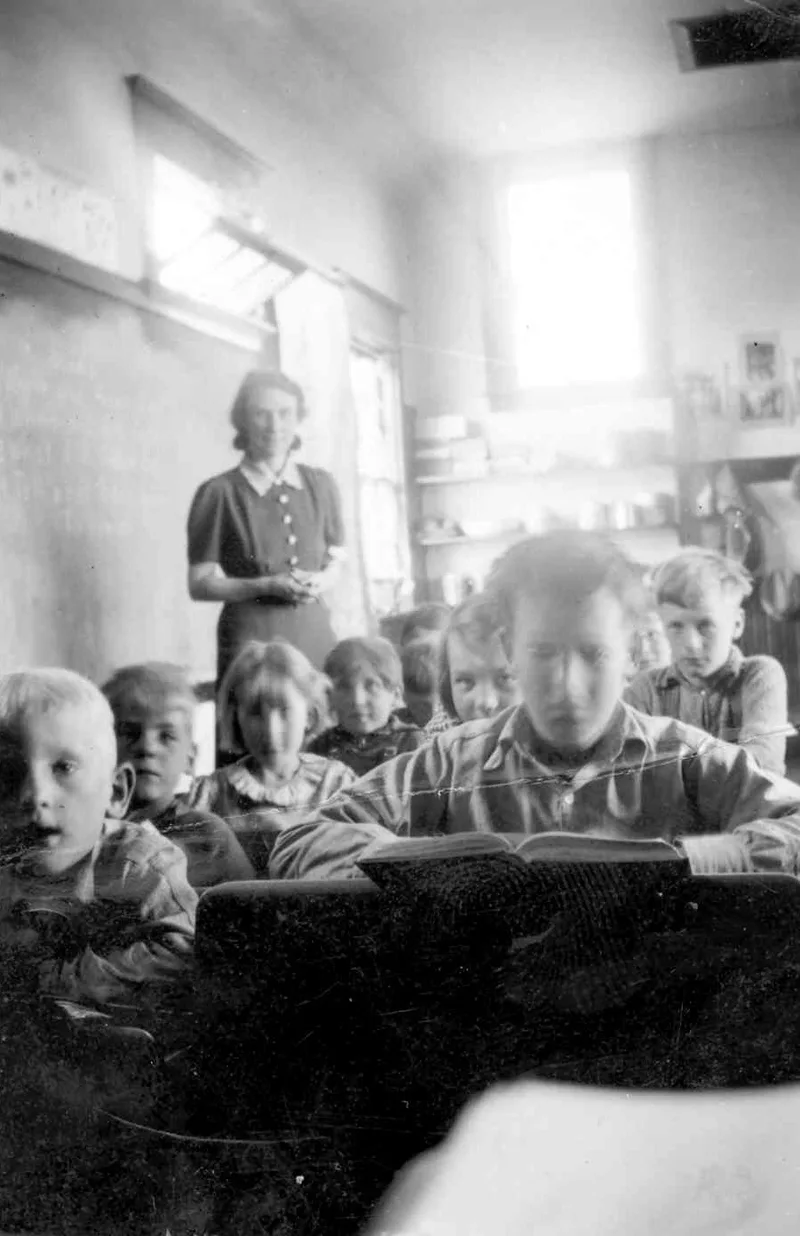
Alice B. Donahue taught at Fair Haven School from 1939 to 1942 and was a regular user of the cage spring and fall. Every morning Alice would cross the river, walk to Todd Richards’ farm then catch a ride in a cart or sleigh to the school with her students. One spring, she had a similar adventure in the cage when the floor of it was knocked out by ice. The operator of the cage, believed to be Geoff Cocke, managed to bring it back to the south side with Mrs. Donahue clinging to the inside of the cage. Legend has it that while the cage was being repaired, she ran to her home near the United Church, changed her clothes and returned to the river to board the cage again. According to the story, she made it in time to start her regular school day. Those of us who remember Alice Donahue believe this to be true.
The saga of the cage continued in November 27, 1936 in The Echo: “For a full month the ferry has been out of commission and not a load of grain or produce has been brought over or provisions taken out. A population of upwards of 2,000 is marooned except for a passenger cage that runs over the ferry cable carrying three or four persons and takes about 20 minutes to do the precarious return trip. The river after freezing up in October has broken up again and this week it has been possible to push a row boat through the running ice at considerable risk. It is fascinating if tragic to watch these patient pioneers bringing what they can over by these means.
“One farmer must have cash and has a few hogs ready for market. He loads them in his wagon and drives them the 15 or so miles to the Landing. Here he finds the ladder up to the cable is not made for pigs to mount even if the pilot would take them, so he negotiates for the loan of a row boat, hog-ties his squealing porkers and one by one he carries them over 30 feet of treacherous ice to where the boat is waiting in the drifting ice, a crate or two of chickens follows as three men jump in and paddle up stream far enough so that they can push out and float with the frazzle to the other side, where the process of unloading is more hazardous as open chasms are spanned by a six inch plank.”
Alice Donahue and students in Fair Haven School. Athabasca Archives, AA04793.
The Echo story continued: “A can of cream, a crate of eggs or a quarter of beef has the same obstacle to meet. On Thursday that husky pioneer from Calling Lake, factiously called Buffalo Bill, after an overland trip of sixty miles engaged a gang of “toughs” to help carry a ton or more of flour, feed and supplies across the river in the same tedious manner, while his team waited for a couple of days. A week’s trip and all that labour and expense for a few necessary supplies is more than should be allowed to continue.”
And in the December 14, 1936, edition: “During the six weeks in which farmers could not get a single load of produce to market the cable cage has been a great boon, and Geoff carried over the running ice upwards of 2000 foot passengers. Supplies were getting pretty low and it was a tedious thing to carry a can of cream up the ladder and bring back a sack of flour after waiting your turn on the cold banks of the river. Women and children and sick persons found the trip bad for the nerves and in the case of a prostrate patient for the hospital, was very difficult.”
In the May 19, 1944 issue of The Echo, a brief submitted by the Athabasca and District Board of Trade was headlined: ‘The Cage Carried Nearly Three Thousand Passengers to Town and Back Across in Month.” The brief went on to say, “For a considerable period of the year, spring and fall, the only means of crossing the river is by means of a well appreciated but now inadequate “cage” service. People manage to get across, even if at times they have to wait their turn; but livestock remains behind and thousands of dollars are now lost each spring and fall through discount for heavy hogs. Then think of the hardship involved in carrying by hand from the North bank of the River to the Creamery the hundreds of egg crates and cream cans, to return not only with empties, but additional loads of groceries, etc. For the fall of 1943, the cage operated from Nov. 4 to Nov. 30, carrying during that period 2,690 passengers and tons of freight.”
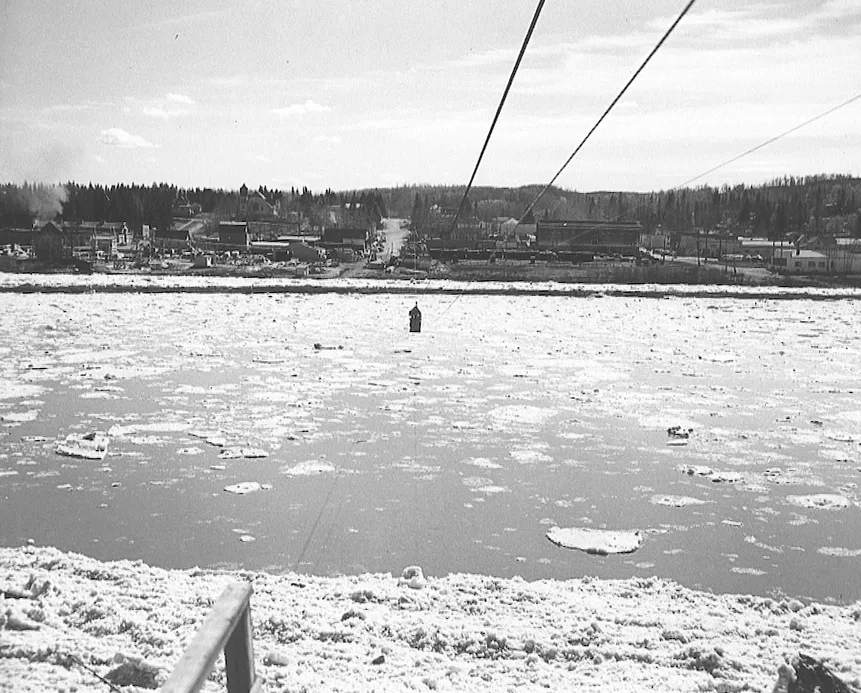
The view of the cage crossing the river from the north bank tower, c. 1940s. Athabasca Archives, AA22893.
