A Bridge is Built
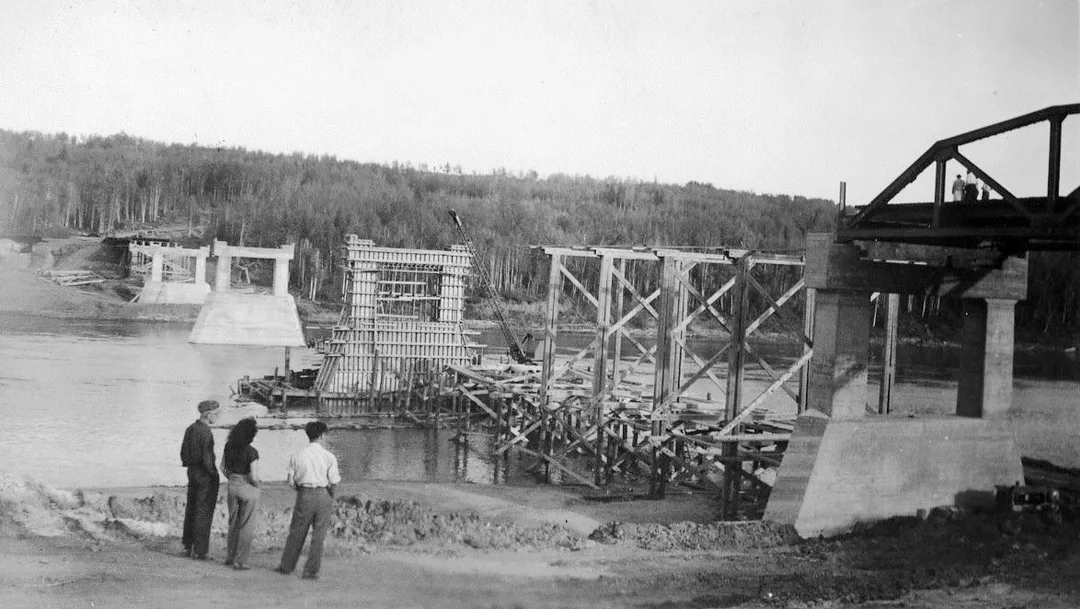
Athabasca Bridge under construction, c. early 1950s. Herman Leicht Fonds. Athabasca Archives AA16584.
Articles in the Athabasca Echo from 1933 to 1935 indicate that increasing pressure was being brought to bear on the provincial government for a bridge over the Athabasca River and that a petition was being circulated to lobby for a traffic bridge.
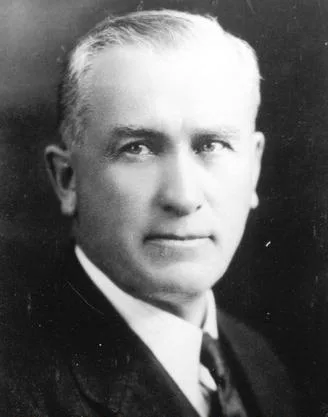
David Milwyn Duggan (May 5, 1879 – May 4, 1942) was a Welsh-born Canadian politician who was the Mayor of Edmonton from 1920 to 1923 and a Member of the Legislative Assembly of Alberta.
On November 24, 1933, the following appeared in the Echo: “Conditions this year for the hundreds of farmers on the north side of the river have become so desperate that something has got to be done about it. We have never let up on our plea for a bridge and when Mr. Duggan was here this week and realized the deplorable situation of about 500 farm families marooned for over five weeks without being able to get anything to or from market – cut off also from all medical or police protection – he made a definite promise that he would do all he could in the House to get government action in the matter. ... He went one better for he called on the Department as soon as he got to Edmonton who promised to fix up some temporary crossing convenience at once.
“To push this grievance home now a petition is being circulated asking for a bridge and nothing but a light traffic bridge will satisfy the people. Every person should sign this petition at once and let a deputation bring it before the government before the session opens. We are well aware of the objections the government can raise but we are certain they can all be met if there is any desire to give present settlers a fair deal and to open up a big new territory that has wonderfully settled in spite of these bi-annual tie-ups.”
On January 26, 1934, the Echo repeated its appeal: “With Premier Brownlee and all the other Premiers of Canada agreeing on a three year public works programme the Board of Trade should snap into action and present our claim for a bridge at Athabasca as of prime necessity. Let us be first in line to greet the chief of the farmer’s government on his return with this farmers’ demand for a traffic bridge. Unless every voter’s name is on that petition and a strong deputation presents it before the Legislature meets we don’t deserve a raft to cross on."
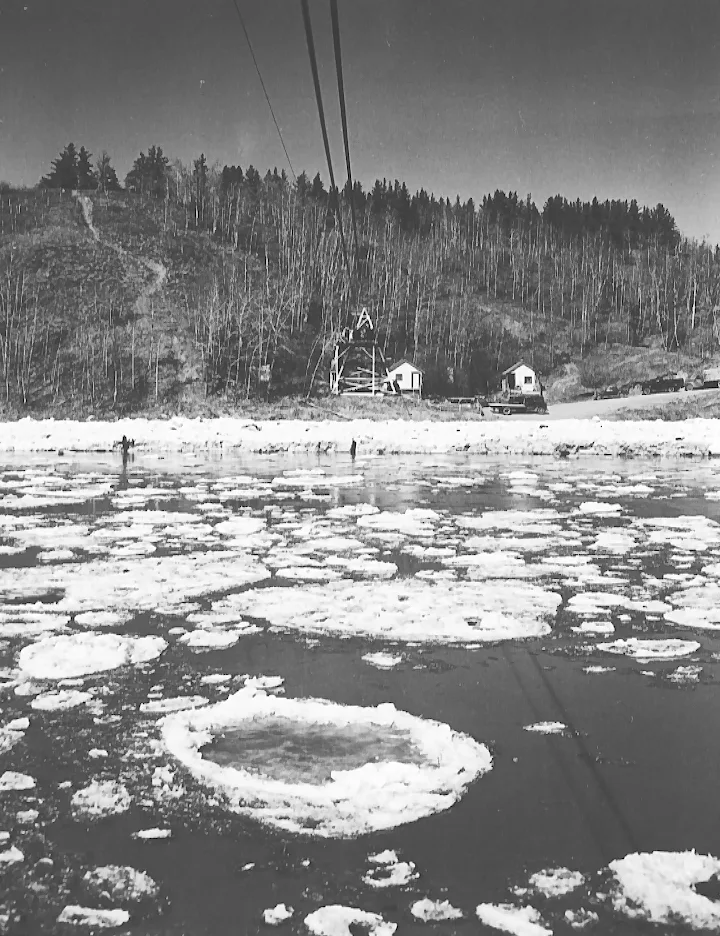
Photo taken from the cage as it crossed the Athabasca River during spring break up, 1949. Athabasca Archives AA22892.
“In the best interests of the Northsiders, Southsiders, Townsmen and Farmers the Echo has nailed its colours to the mast and will do all it can to prove to the Government that a Bridge at Athabasca is one of the public works that cannot wait any longer. But the Board of Trade, the Town Council and every farmer must line up and push. Let us send a deputation to Edmonton backed up with every voter in the district. Now is the time to act. Will the Board of Trade call a mass meeting of farmers instead of its annual banquet this year and get a committee to fill up the petition and prepare the brief for the biggest deputation that has ever gone south?”
Mr. D. M. Duggan did follow through on the promise he made earlier at a meeting in Parker’s Hall to question the assembly about what had been done. The provincial governments’ response was to install the infamous cage. The responses to Mr. Duggan’s questions were reported in the Athabasca Echo of February 22, 1935. When asked if the government had ever estimated the cost of a low-level traffic bridge, the response was that they had determined it would be approximately $150,000. They then confirmed that facilities are provided for daily use during freeze-up and thawing periods – a cable carriage operated by small engine at a cost of $413.08. They went on to say that from April 16 to December 15 of 1934 the operating expense to the government was $35.80 and from November 2 to December 15, 1934 it was $160.83. (Not sure why the time periods overlap). The government admitted that no such facilities had been provided prior to the spring of 1934. When asked if they had been “advised of privation, suffering or death of any settler North of the river due to failure of relief or medical officers to cross the river,” the response was that in the fall of 1933 complaints had been received of inconvenience during freeze up. They had no record of any death due to these circumstances. In addition, they had no record of how long the periods were that crossing facilities were unavailable.
Progress appeared to stall for ten years. Economics conditions worsened, there was a war and for a time, Athabasca had no newspaper. Then on November 2, 1945, the Athabasca Echo described the creation of a petition to the provincial government: “Residents of the far-flung territory north of the river are “going to town” in more ways than one. Not only have they been signing up a ponderous petition for a bridge across the Athabasca, and priming their guns for the campaign with a series of meetings, but this week the go-getting Barney Ryan hied himself off to Edmonton to personally arrange with Premier Manning and Public Works Minister Fallow for the reception of a delegation. And Barney stressed to the Echo that he hoped to camp in the vicinity of the big dome until he makes a date and will then hail his colleagues on the Big Four to the big town.
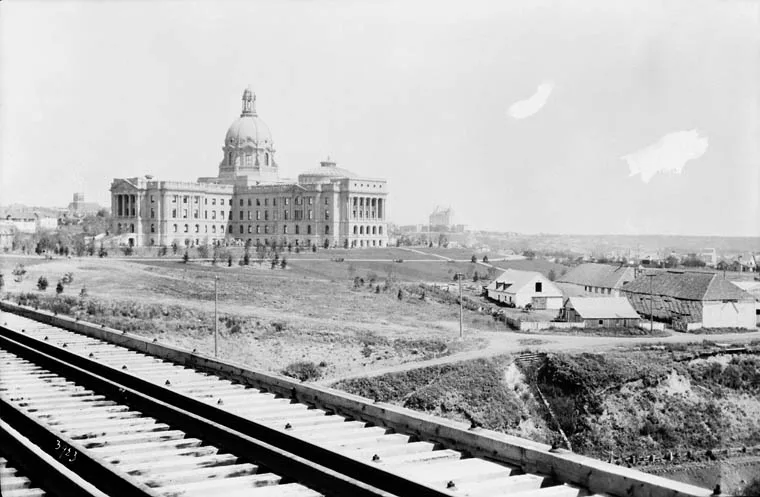
View of Alberta Legislature Building and old Fort Edmonton from High Level Bridge, 1914. The photo was taken a few years before Barney Ryan's trip to Edmonton. Library and Archives Canada, PA-011278.
“A meeting of residents of the Big Coulee sector was held last week, at which G. Tomlinson took the chair, and Mr. Ryan presented a summary of developments to date. A letter to the Department of Public Works, from the pen of Dr. E. K. Wright, was read to the meeting, stressing the need of a bridge, and Mr. Ryan stated that a supporting letter from the inspector of schools would be forthcoming at an early date. O. A. Kennedy, of Edmonton, addressed the meeting, outlining the important factors to be brought to the attention of the authorities by any delegation in regard to the vital necessity of a bridge project. Incidentally, it is claimed that over thirty school children during the Athabasca tie-up must shiver in the wintry blasts, awaiting their turn at transportation via the cage route, to and fro, five days a week.
“Judging from reports which seep out from the session, Ludwig Silvers waxed considerably short on enthusiasm for the undertaking. The way we hears it is that Mr. Silvers expressed the opinion that at the present time the sanction of a bridge could not be obtained because the Federal Government, in his opinion, would give no help as to finance and that the Provincial Government could not finance the whole coast of such a venture. He strongly advised that steps be taken to obtain better ferry and cage facilities for the immediate future.
“A resolution sponsored by Barney Ryan and Paul Kawulok calling on the Provincial Government to take immediate steps to build a bridge was carried unanimously by the residents of the community. A further resolution was moved by Messrs. P. Kawulok and M. Gora that Mr. Ryan present the resolution to the Provincial Government and carried, it being provided that a supporting delegation of three be elected, one from Big Coulee, one from Richmond Park and one from Sawdy. The delegation will consist of P. Kawulok, R. G. Davidson, and G. Tomlinson.”
The paper went on to print the resolution:
WHEREAS we, the residents of the district situate north of the Athabasca River urgently need some better means of transportation across the above named river; and
WHEREAS, this district is one of the best potential agricultural districts in the whole of Canada and has proven its ability to produce some of the finest seed grain obtainable, namely alfalfa and clover; and
WHEREAS, there are many children who are handicapped in their education because of the lack of transportation to better facilities of education and many of them being deprived of the privilege of finishing their school training; and
WHEREAS, many of our people at various times need hospital care and on many occasions during the time when the ferry is unable to operate, and untold suffering and grave danger to life is incurred; and
WHEREAS, this is the gateway to a great section of the north country which is rich in fur, game, fish and minerals; and
WHEREAS, we are sure that a bridge is absolutely necessary, not only for the above named reasons, but that a bridge would open up and develop one of the best parts of Alberta; therefore be it
RESOLVED that we humbly petition the Provincial Government of Alberta to take immediate steps to build a bridge across the Athabasca River at a point near the town of Athabasca; and be further
RESOLVED that we tender to the Government the petition that has been subscribed to by the vast majority of the people in this district.
Three weeks later it was noted in the Athabasca Echo of November 23, 1945, that the Athabasca and District Board of Trade had thrown their support behind the petition. The previous year President Godel had submitted a brief to the Board of Trade noting that there had been a 450 per cent increase in ferry traffic over the previous sixteen years and that the cage had carried nearly 3,000 passengers to town and back in one month. They dispatched a wire to the Hon. W. A. Fallow: “Athabasca and District Board of Trade in regular meeting heartily endorses representations being made to the Honourable Minister of Public Works by the farming community north of the river, supported by a largely signed petition, for the early construction of a bridge over the Athabasca River at or in close proximity to the town. In doing so we but reiterate the sentiments expressed by this Board in the form of a brief submitted to the Provincial Post-War Reconstruction Committee several months ago and which met with highly favorable comment by that body.”
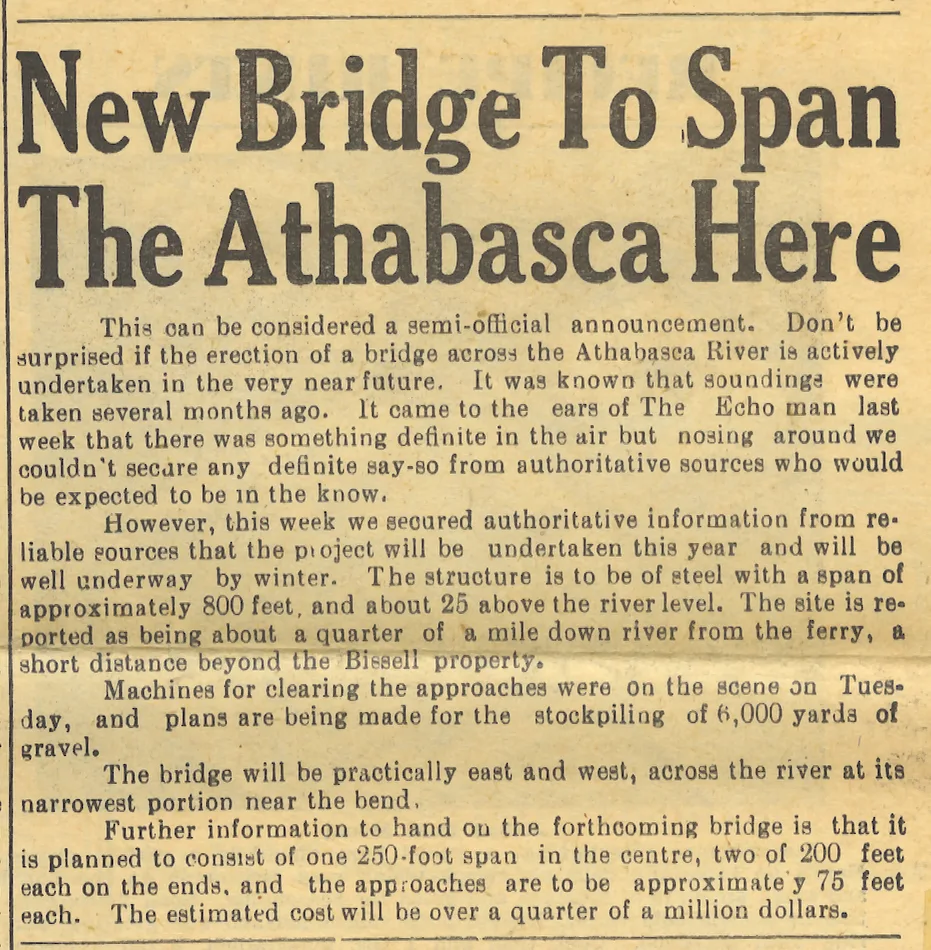
Athabasca Echo September 1, 1950. Athabasca Archives Newspaper Collection.
Five years later, the Athabasca Echo of September 1, 1950, scooped the big announcement with the headline “New Bridge To Span The Athabasca Here”. The Echo reported: “This can be considered a semi-official announcement. Don’t be surprised if the erection of a bridge across the Athabasca River is actively undertaken in the very near future. It was known that soundings were taken several months ago. It came to the ears of The Echo man last week that there was something definite in the air but nosing around we couldn’t secure any definite say-so from authoritative sources who would be expected to be in the know.
“However, this week we secured authoritative information from reliable sources that the project will be undertaken this year and will be well underway by winter. The structure is to be of steel with a span of approximately 800 feet and about 25 above the river level. The site is reported as being about a quarter of a mile down river from the ferry, a short distance beyond the Bissell property. Machines for clearing the approaches were on the scene on Tuesday, and plans are being made for the stockpiling of 6,000 yards of gravel. The bridge will be practically east and west, across the river at its’ narrowest portion near the bend. Further information to hand on the forthcoming bridge is that it is planned to consist of one 250-foot span in the centre, two of 200 feet each on the ends, and the approaches are to be approximately 75 feet each. The estimated cost will be over a quarter of a million dollars.”
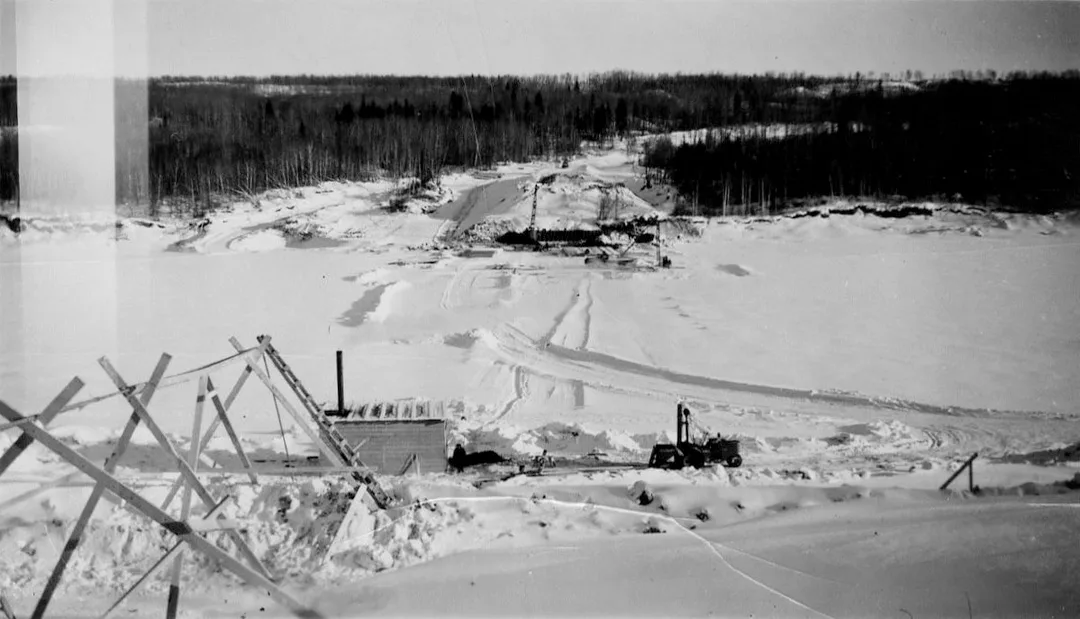
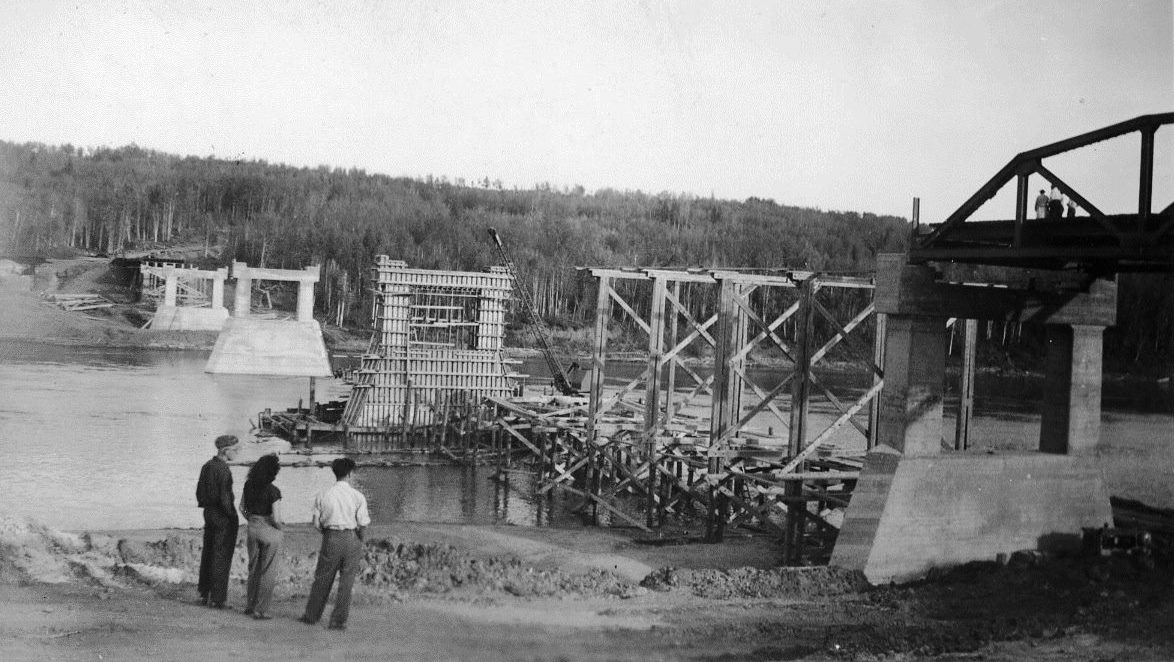
A view of the bridge construction from the north shore of the river. Walter Steinle Fonds, Athabasca Archives, AA17043.
Two weeks later, the Echo reported: “Town Public works officials and Mr. L. H. Cullerne, District Engineer; Mr. Gimble, Bridge Engineer, Charles Arkinstall who is the contractor supplying the gravel for the new bridge and secretary McCallum and Building Inspector Evans had a conference in the town offices on Thursday morning. Plans are moving along smoothly, and Mr. Frank Crawford is expected to be furnishing the piling material, which is understood to be of tamarac, in the future. Developments yesterday disclosed that the government was not planning on changing the roadway north of the river this year or next year. For the present, the approach to the bridge will tie on to the road to the gravel pit, and an approach will be built on this side of the river.”
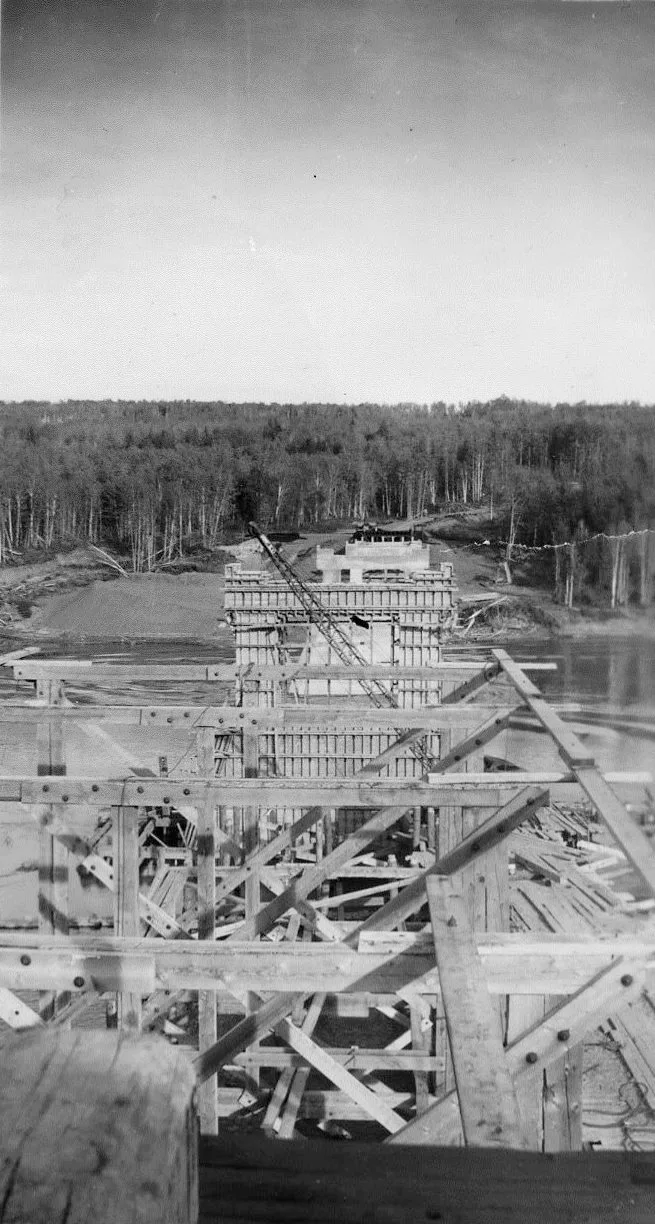
Herman Leicht Fonds, Athabasca Archives, AA16585.
Walter Steinle worked on the construction of the bridge. Walter provided the Archives with pictures of the bridge under construction and, in an accompanying letter to then archivist Marilyn Mol, described some of his experiences: “…The bunk house was slapped together in Edmonton and hauled out in chunks for us to patch together. Why, we did not know since we had good carpenters on the crew. We built a huge cook house and mess hall. It would seat 70 men. Many other sheds and storage places were built... It’s a shame that the shaping and bending equipment we built and used to shape those huge rebar rods was not preserved (1 in by 40 ft).”
Walter worked with the rebar used in creating the bridge and said he had many helpers. Others he remembered were chief engineer Larry Bush, overall foreman Gordon Harps, blacksmith Cliff Brown, dragline operators Al Dittman, Cunningham and Gerald Calvert, head carpenter Nels, and other men involved in general work – Orvil Maynhood, Hugo Coli, Ozzie Lipscombe and Modest Paul. There were many more workers. They were often the come-and-go type and many times the mess hall would not seat them all.
Walter included a couple of anecdotes: “A group of us guys walked up town on a Saturday afternoon. Had some supper, played some pool until about 9 o’clock. I started back to camp on my own. About half way across the ice I lost the truck track I was following. As I stood quietly, I found out why it was lost, the ice was breaking up. I had a good [flashlight]; was able to spot the far shore, stepped very carefully from cake to cake and made it safely. Now was the time for fear. [I] went on to camp and to bed. Someone must have missed me, the cops were called. They crossed on the cable car, entered the tent [and] popped me.
“There came a day when an old gent walked into camp…Poorly dressed and he appeared to be alone. Gordon Harps being a good guy offered him work. He would help the camp caretaker. Mr. McCabe soon found out he was not alone, but had many little helpers on his body. He was taken to public health service, [and] it took a long time to clear him up. His bunk was in a small tool shed, he took his food in there too. [We] went to work one morning and Westlock Jim was gone. He [had] spent his first few days in the big bunk house until his problem was discovered, [which] explains why I preferred the tent.”
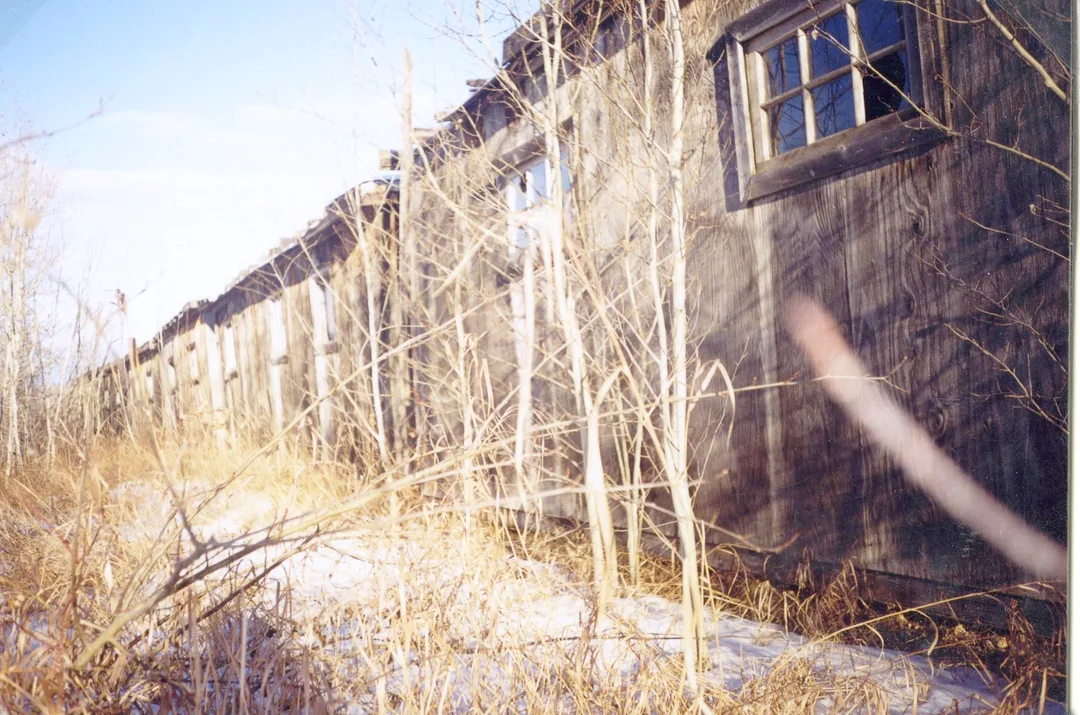
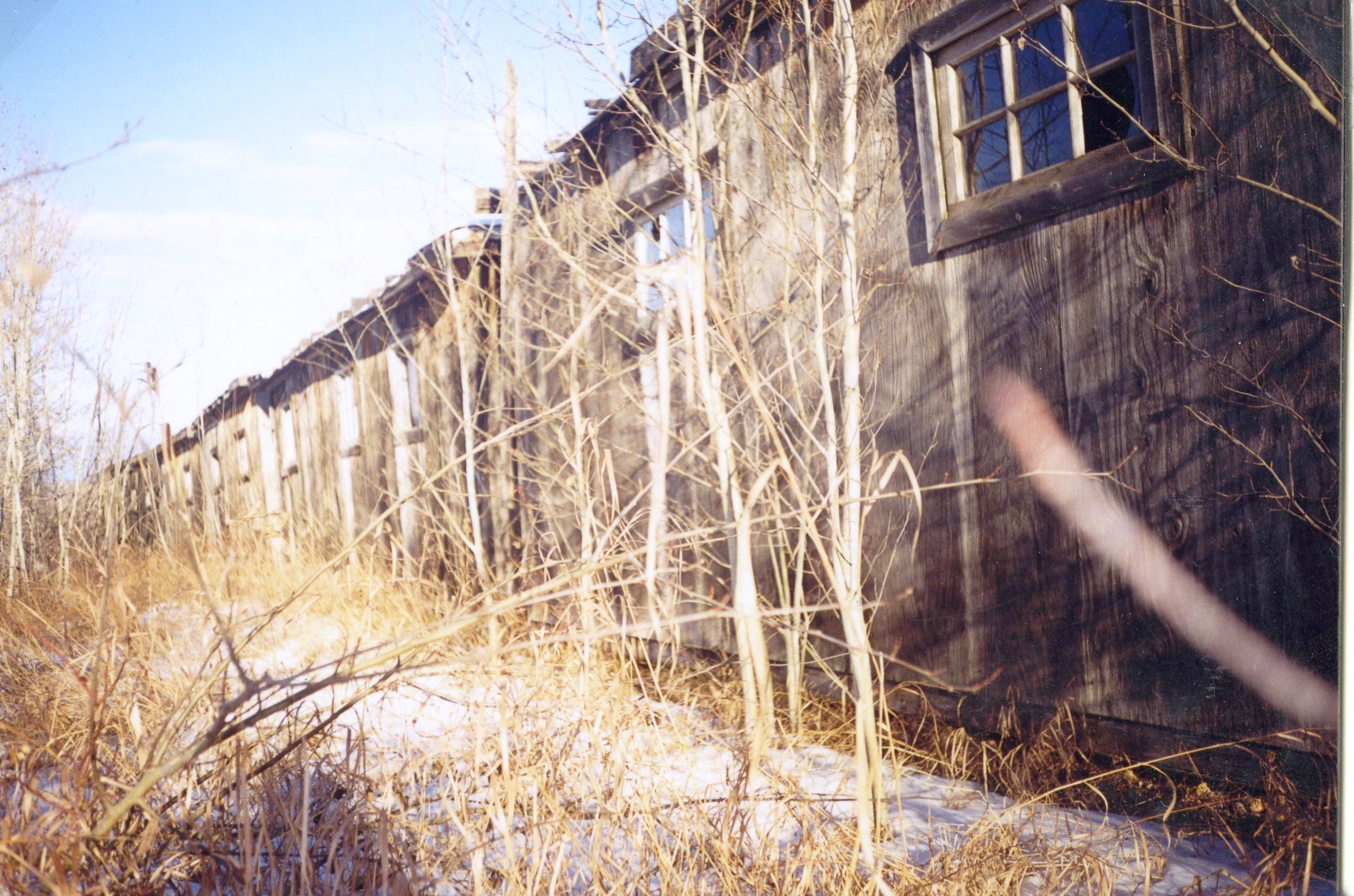
Taken many years after the bridge was finished, a view of the shack accommodations built for the construction crew. Photo by Sherry Young. Athabasca Archives AA17955.
No doubt bridge work was hard and occasionally dangerous. Much of it was done in the dead of winter. George Ryga, author and playwright who grew up north of Athabasca, also worked on the bridge. His experience was an unfortunate one and was described in The Athabasca Ryga, edited by E. David Gregory, “One day in the early winter months of 1951, Ryga’s job helping construct the Athabasca Bridge came to an abrupt end. His right hand was caught in a pulley, and in a few tragic seconds two fingers and part of a third were torn off.”
In March of 1952, the Athabasca and District Board of Trade commenced planning for the bridge opening. They hoped to have it coincide with the birthday of Queen Elizabeth, discussed possible dignitaries, a parade, games, entertainment, booths and a band. A list of committees would be organized and a commemorative programme created.